Carb counting is how many people with diabetes match food and insulin. If you take mealtime insulin, the count is what your dose is based on. If you don't, counting still helps you keep meals more even and see which ones push your numbers up. I've had type 1 since 2006 and I count every meal. This is how it works in practice.
What counts as a carb, and why it matters
Carbohydrates come in three types, according to the CDC:
- Sugars: the natural sugar in fruit and milk, and the added sugar in soda and many packaged foods.
- Starches: wheat, oats and other grains; starchy vegetables such as corn and potatoes; dried beans, lentils and peas.
- Fiber: the part of plant foods your body doesn't digest.
Sugars and starches raise blood sugar. Fiber doesn't. Protein and fat aren't counted as carbs, but they still matter: the American Diabetes Association notes that a meal high in protein and fat can change how quickly the carbs are absorbed. That's one reason pizza night often looks different in a log from a bowl of pasta with the same grams.
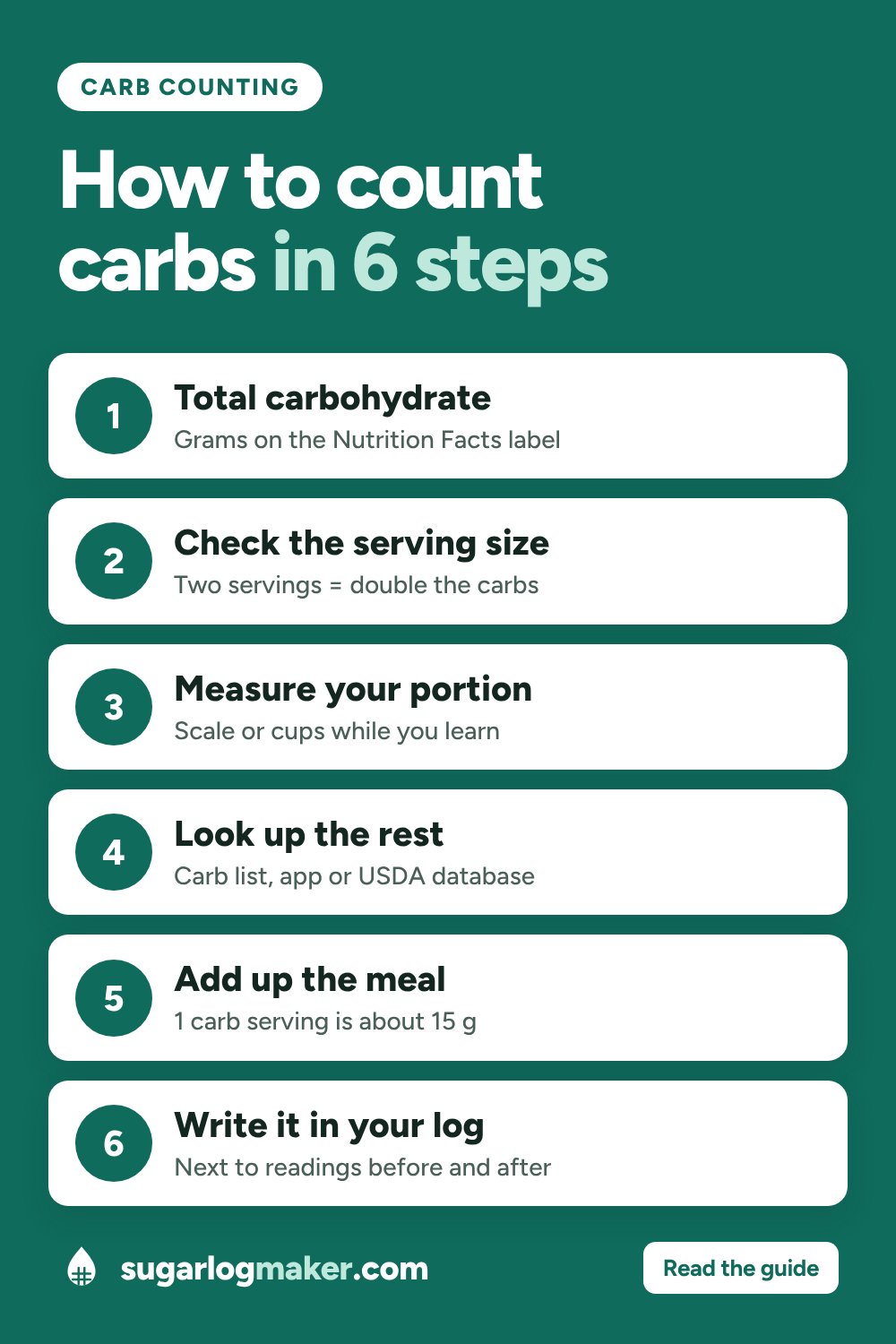
How to count carbs, step by step
- Find the total carbohydrate. On a Nutrition Facts label, look at grams of total carbohydrate. The ADA explains that this number already includes sugar, starch and fiber, and added sugars are part of it too, so you don't add them again.
- Check the serving size. All the numbers on the label are for one serving. If you eat two servings, double the carbs. If the box says 30 g per cup and you pour a cup and a half, that's 45 g.
- Measure your portion. At the start, use a kitchen scale or measuring cups. Your eye gets better with time, but it starts out optimistic.
- Look up foods without a label. Fruit, bread from the bakery, a home-cooked stew: use a carb list, an app, or the USDA's FoodData Central database, which the ADA points to.
- Add up the meal. Every food and drink with carbs goes into the total, in grams. Milk in coffee counts. So does the juice.
- Write it down. The total goes in your log next to the reading before the meal and the one after. Without that, the count is only a number.
Grams or carb servings: two ways to count
Carbs are counted in grams. Some people use a simpler unit instead, a carb serving or "carb choice". The CDC and the ADA both put one serving at about 15 grams of carbs.
| Grams of carbs | Carb servings | Note |
|---|---|---|
| about 15 g | 1 | 1 carb serving or "carb choice" (CDC, ADA) |
| about 30 g | 2 | a small baked potato (CDC example) |
| about 45 g | 3 | a small baked potato plus 1 more serving |
A carb serving is not the same as a normal serving of food. The CDC's example is the small baked potato: most people would call it one serving, but at about 30 grams it counts as two carb servings.
Which way is right for you depends on your treatment. The ADA says counting every gram and using an insulin-to-carb ratio is the method for people on intensive insulin therapy, by injections or pump, such as people with type 1. People with type 2 who don't take mealtime insulin often use carb servings or the Diabetes Plate Method, where carb foods fill a quarter of the plate. Your diabetes team or a dietitian will tell you which method fits you. Whichever unit you use, keep the same one on every page of your log.
Carb counting for type 1 diabetes: matching carbs and insulin
With type 1, your body doesn't make insulin, so you take it for the food you eat. The ADA describes the method: you count the grams in the meal and use your insulin-to-carb ratio to work out the dose. Your ratio, and any change to it, comes from your doctor or diabetes nurse. Please don't work one out on your own from a website, this one included.
The CDC adds a useful point. If you don't use mealtime insulin, eating about the same amount of carbs at each meal helps keep your blood sugar steady through the day. If you're on a pump or multiple daily injections, you don't need to keep meals the same, because the mealtime insulin is matched to what you eat. That flexibility is the main reason people with type 1 count so carefully.
If you want to keep the doses, readings and carbs on one page, I wrote a separate guide on how to log insulin doses and carbs.
How many carbs should you eat per meal?
There is no single number. The CDC says there's no one-size-fits-all answer, because it depends on your age, weight, activity level and more. The ADA says the same: there's no magic number per meal, and a dietitian or diabetes educator can work out a plan with you. In the US, ask your doctor about diabetes self-management education and support (DSMES), where this is part of the program.
For what it's worth, here is what a normal day looks like for me: about 90 g of carbs at breakfast, about 150 g at lunch and about 60 g at dinner, plus snacks between meals when I need them. That's my own, not a target for you. It fits my body, my activity and my insulin, and yours will be different.
A good first step, from the ADA: for a few days, write down what you eat and check your blood sugar before meals and about 2–3 hours after. That shows you and your team how many carbs you eat now and what they do to your numbers.
What I've learned counting carbs every day since 2006
Once you're used to it, carb counting isn't hard. I count every meal and most of the time it takes seconds, because I know the foods I eat often. The ADA says the same thing: the longer you count, the more you remember.
New foods are still a challenge. A dish I've never had, a restaurant meal, a cake someone baked: I estimate, and I watch the numbers afterwards. (A new menu is still a small math exam, twenty years in.)
The grams are only part of it. Different people react differently to the same food, and the same food can do different things to me on different days. So I always look at the whole picture:
- how active I am at the time, and how active the day has been;
- my state of mind and how I feel;
- which foods I'm eating together;
- how much of each.
All of that changes what a given number of grams does to my glucose.
I think the most useful thing to accept early is that you will get carb counts wrong. Everyone does, me included. It's normal. What matters is knowing how to deal with the mistake and staying on track with the A1C you and your doctor are aiming for. The log is how you find out which way you were wrong.
How to log your carbs so the count teaches you something
A count you don't write down is gone by tomorrow. A count next to two readings is something you can learn from. For each meal, write:
- the reading just before you eat;
- the meal in a few words and the total carbs in grams;
- insulin, if you take it with meals;
- the reading after the meal, at the time your team suggests;
- anything unusual: a walk, a stressful meeting, a late meal, a fatty dinner.
Here is what a few rows can look like. The numbers are a made-up example, not my readings:
| Meal | Carbs | Before | 2 h after | Note |
|---|---|---|---|---|
| Oatmeal, banana | 60 g | 110 (6.1) | 150 (8.3) | as usual |
| Sandwich, apple | 55 g | 120 (6.7) | 200 (11.1) | bakery bread, guessed |
| Pizza, 2 slices | 70 g | 115 (6.4) | 140 (7.8) | higher again at bedtime |
Readings in mg/dL, mmol/L in brackets. Read this way, the second row says "check that bread" and the third says "the fat in pizza shows up later". For reference, the ADA target for most adults with diabetes is below 180 mg/dL (10.0 mmol/L) 1–2 hours after starting a meal, and 80–130 mg/dL (4.4–7.2 mmol/L) before meals. Your own targets come from your doctor.
A before and after meal log has these columns ready to print. After a week or two, the pairs show which meals you count well and which you don't. The guide on finding the foods that spike your blood sugar explains how to read them.
When a count goes wrong: lows and highs
If you take insulin for a meal and then eat fewer carbs than you counted, your blood sugar can go low. The ADA defines low blood sugar as below 70 mg/dL (3.9 mmol/L), and below 54 mg/dL (3.0 mmol/L) as a level that needs treating right away. Treat a low the way your diabetes team taught you, check again, and write it in your log with the meal that came before it.
If you counted fewer carbs than you ate, you may run high after the meal. Don't take extra insulin unless your team has taught you how to correct. If you have type 1 and you are high and feel unwell, check your ketones as your team showed you and call them.
Not medical advice. This guide is general information. Your targets, testing times and treatment come from your doctor, diabetes nurse or clinic, who know your situation.
Make a before and after meal logMeal, carbs and both readings side by side. Free to print, mg/dL or mmol/L.Questions
How do I count carbs for diabetes?
Add up the grams of total carbohydrate in everything you eat and drink at a meal. Use the Nutrition Facts label for packaged foods, adjusting for how many servings you eat, and a carb list or app for the rest. Write the total in your log with your readings before and after the meal.
How many grams of carbs is one carb serving?
About 15 grams, according to the CDC and the ADA. A small baked potato, at about 30 grams, counts as two carb servings.
How many carbs should a person with diabetes eat per meal?
There's no single number. The CDC and the ADA both say it depends on things like your body size, age and activity level. A dietitian or diabetes educator can work out a plan with you.
Does fiber count when counting carbs?
Fiber is part of the total carbohydrate on a label, and the ADA suggests counting the total. The CDC notes that fiber itself doesn't raise blood sugar. Ask your diabetes team which way they want you to count.
Do I need to count carbs if I have type 2 diabetes?
Not always in detail. The ADA says people with type 2 who don't take mealtime insulin may use carb servings or the Diabetes Plate Method instead. People who take mealtime insulin usually count every gram.
What if I get my carb count wrong?
It happens to everyone who counts. Write the meal, the count and both readings in your log, so you can see whether you counted too high or too low and do better next time. If you go low, treat it the way your diabetes team taught you.
Sources
- CDC. Carb Counting
- American Diabetes Association. Carb Counting and Diabetes
- American Diabetes Association. 6. Glycemic Goals, Hypoglycemia, and Hyperglycemic Crises: Standards of Care in Diabetes—2026. Diabetes Care 2026;49(Suppl 1)
- American Diabetes Association. DKA: Signs, Symptoms, and Treatment