Why is my blood sugar higher in the morning?
You haven't eaten for eight hours, so a high number before breakfast feels wrong. There is a reason for it, though. The American Diabetes Association names three common causes.
1. The dawn phenomenon
Between about 3 and 8 a.m., hormones such as cortisol and growth hormone tell your liver to release more glucose, to give you energy for waking up. Without diabetes, the pancreas answers with more insulin and the level stays put. With diabetes, there may not be enough insulin to match it, so you wake up higher than you went to bed. The ADA says about half of people with type 1 or type 2 diabetes have it.
2. Insulin that runs out overnight
If there is too little insulin in your body in the early hours, your level rises. This can happen when a long-acting insulin wears off before the next dose, when the dose is too low, or when pump settings give too little background insulin at night.
3. A rebound after a low (the Somogyi effect)
If your blood sugar drops too low during the night, for example after a missed dinner or too much insulin in the evening, your body releases glucose to correct it, and you can wake up high. The ADA calls this the rarest of the three. It still matters, because the answer to it is very different from the answer to the other two.
There are everyday reasons as well: a large or late dinner, a snack at bedtime, or too little insulin or medicine with the evening meal. If you go to bed high, you will often wake up high.
What should my blood sugar be when I wake up?
For most adults with diabetes, the ADA target before meals, including first thing in the morning, is 80–130 mg/dL (4.4–7.2 mmol/L). For adults with type 1, NICE in the UK suggests 90–126 mg/dL (5–7 mmol/L) on waking. Your own target comes from your doctor.
| Morning reading | mg/dL | mmol/L |
|---|---|---|
| Adults with diabetes, before meals (ADA) | 80–130 | 4.4–7.2 |
| Adults with type 1, on waking (NICE) | 90–126 | 5–7 |
| Normal fasting level without diabetes (CDC, lab test) | 99 or below | 5.5 or below |
| Low (ADA) | below 70 | below 3.9 |
My own morning target is tighter: 70–99 mg/dL (3.9–5.5 mmol/L). That's my own, not a target for you. Tighter targets bring a higher risk of lows, so agree yours with your doctor. All the ranges side by side, with a printable PDF, are in the blood sugar levels chart.
One high morning won't change much. The ADA notes that an occasional morning high has little effect on your A1C, but highs on most mornings can push it up. That's why the pattern matters more than any single number.
How to find the cause: three readings for a few nights
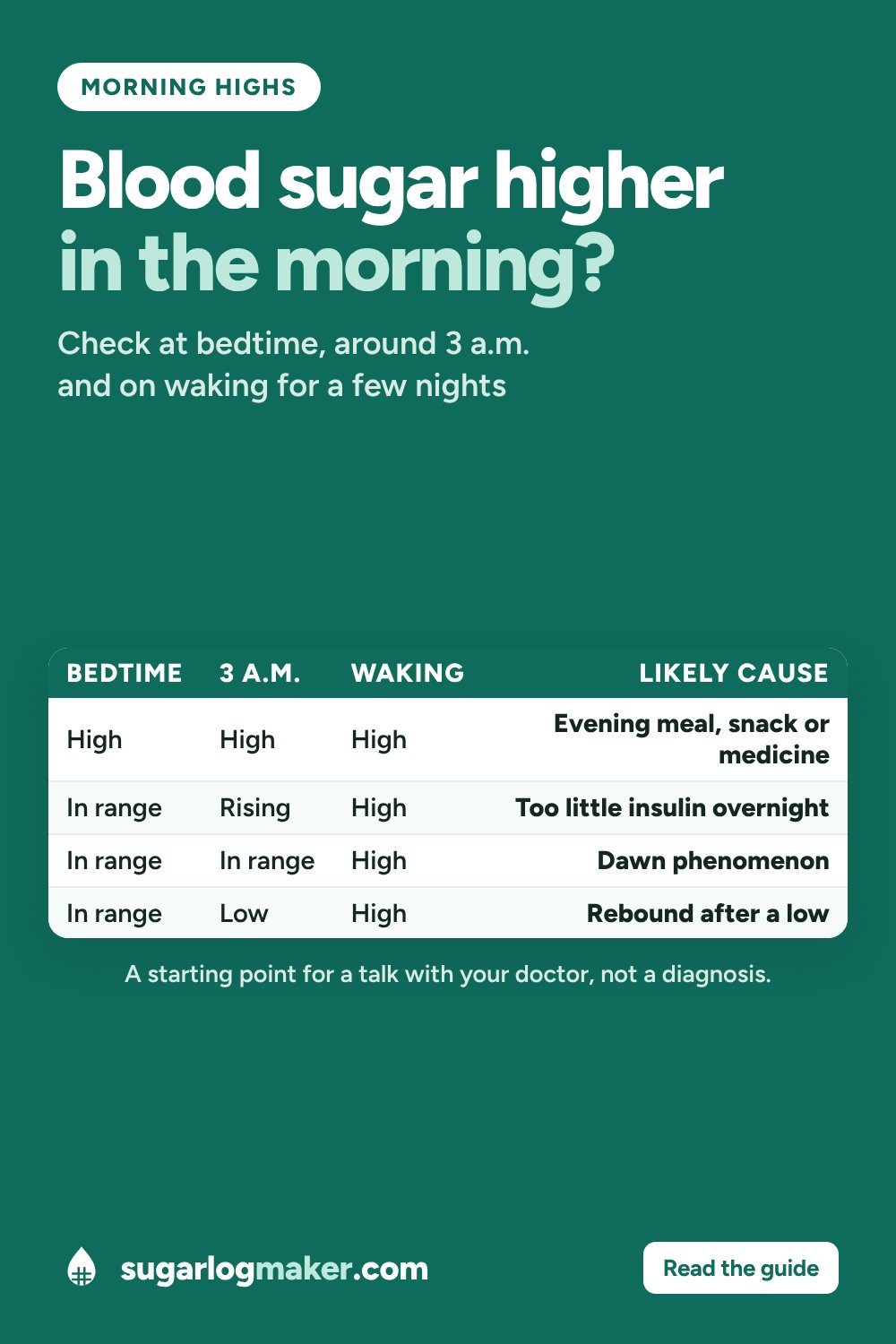
At 7 a.m. the three causes look exactly the same. At bedtime and at 3 a.m. they look different. The ADA suggests checking at bedtime, in the middle of the night and when you wake up, for a few nights in a row. If you use a CGM, it collects the night for you while you sleep.
| Bedtime | Around 3 a.m. | On waking | Likely cause |
|---|---|---|---|
| High | High | High | The evening meal or snack, or the medicine with it |
| In range | Already rising | High | Too little insulin overnight |
| In range | In range | High | Dawn phenomenon (the rise starts in the early hours) |
| In range | Low | High | Rebound after a night-time low |
Treat this table as a starting point for a talk with your doctor, not a diagnosis. Real nights are messier than four rows, and two causes can happen together.
On paper, you need three columns: Bedtime, 3 a.m. and On waking. This link opens the log maker with those three columns already set up for two weeks. Use the notes box for the evening meal, the time you ate it, any insulin, and anything unusual: a late workout, a stressful day, a glass of wine. Set an alarm for the night check. (My meter has never once told me what I wanted to hear at 3 a.m. It's still worth asking.)
Three to five nights is usually enough to see a shape. If you don't usually check at night, read when to check your blood sugar for the other times worth adding.
How to lower blood sugar that's high in the morning
The answer depends on the cause. If you use insulin or other diabetes medicines, any change to them is for you and your doctor or diabetes nurse to decide, so please don't change doses on your own. These are the things the ADA says your care team may look at:
- High at bedtime: what and when you eat in the evening, a snack before bed, and the insulin or medicine with your evening meal.
- In range at bedtime, high on waking: the timing or type of your long-acting insulin, or your pump's settings for the night.
- Dawn phenomenon: a higher long-acting dose can bring the morning down but cause a low earlier in the night, so your doctor may decide not to raise it on its own. Some people use a pump set to give more insulin in the early hours.
- Rebound after a low: the night-time low is the thing to sort out first.
- No insulin: it can take some trial and error with your doctor to find the medicine and routine that bring mornings down.
Movement helps too. According to the ADA, an after-dinner walk can help keep levels down overnight, and morning exercise can help with the dawn phenomenon. Exercise before bed can keep lowering your blood sugar for hours and cause a low at night, so check before you go to sleep.
What makes a difference for me
I've had type 1 since 2006, and physical activity is a big part of how I manage it. In the short term it lowers how much insulin I need. Over the long term it makes my numbers steadier, with smaller swings. Yoga and breathing do something else: they take the tension out of my body, and I come out of them calmer and better able to concentrate.
I think insulin is the one part of type 1 you can't skip. On top of it, food, movement and stress make a big difference for me, and they are worth bringing up with your doctor along with your doses.
When you go to your next appointment, take the nights you logged. "My mornings are high most days, and here are three nights of readings" is a question your doctor can work with. The guide on bringing your log to a doctor's appointment shows how to mark the pattern.
When a high morning reading needs help now
If you have type 1 diabetes, a high reading together with feeling unwell can be a sign of diabetic ketoacidosis (DKA). The ADA lists these warning signs:
- nausea and vomiting;
- stomach pain;
- rapid or heavy breathing;
- confusion or trouble concentrating;
- extreme tiredness;
- fruity-smelling breath;
- thirst or a very dry mouth.
Check your ketones the way your care team showed you, and call them. The ADA says a blood ketone level of 1.6 mmol/L or higher needs emergency medical care straight away.
Lows at night matter as well. Below 70 mg/dL (3.9 mmol/L) is low, and below 54 mg/dL (3.0 mmol/L) needs treating right away, according to the ADA. Treat a low the way your diabetes team taught you, and write it in your log so your doctor sees it.
Not medical advice. This guide is general information. Your targets, testing times and treatment come from your doctor, diabetes nurse or clinic, who know your situation.
Make your 3-night morning logBedtime, 3 a.m. and On waking columns, ready to print. Free, no account.Questions
Why is my blood sugar higher in the morning than at bedtime?
Usually one of three things: the dawn phenomenon (hormones that raise blood sugar between about 3 and 8 a.m.), insulin running out overnight, or, less often, a rebound after a low during the night. A reading around 3 a.m. for a few nights helps tell them apart.
Is it normal for blood sugar to be higher in the morning without diabetes?
The same early-morning hormones work in everyone, but without diabetes the pancreas releases more insulin and the level stays in range. A normal fasting lab result is 99 mg/dL (5.5 mmol/L) or below, according to the CDC. If your morning readings are often higher, see a doctor: one home reading is not a diagnosis.
What should my blood sugar be when I wake up?
For most adults with diabetes, the ADA target before meals is 80–130 mg/dL (4.4–7.2 mmol/L). NICE suggests 90–126 mg/dL (5–7 mmol/L) on waking for adults with type 1. Your doctor will set the target that's right for you.
What time does the dawn phenomenon happen?
The ADA puts it between about 3 and 8 a.m. That's why a check in the middle of the night, or a CGM, is the best way to see it.
How can I tell the dawn phenomenon from the Somogyi effect?
Check around 3 a.m. If you're in range then and high on waking, the dawn phenomenon is more likely. If you're low at 3 a.m. and high on waking, it may be a rebound after a low. Show your readings to your doctor before changing anything.
Can people with type 2 diabetes have high blood sugar in the morning?
Yes. The ADA says about half of people with type 1 or type 2 diabetes have the dawn phenomenon. If you don't use insulin, your doctor may adjust your medicine or routine to bring mornings down.
Sources
- American Diabetes Association. High Morning Blood Glucose: Understanding and Management
- American Diabetes Association. 6. Glycemic Goals, Hypoglycemia, and Hyperglycemic Crises: Standards of Care in Diabetes—2026. Diabetes Care 2026;49(Suppl 1)
- NICE guideline NG17. Type 1 diabetes in adults: diagnosis and management
- CDC. Diabetes Testing
- American Diabetes Association. DKA: Signs, Symptoms, and Treatment